

BY: Mustapha Lawal
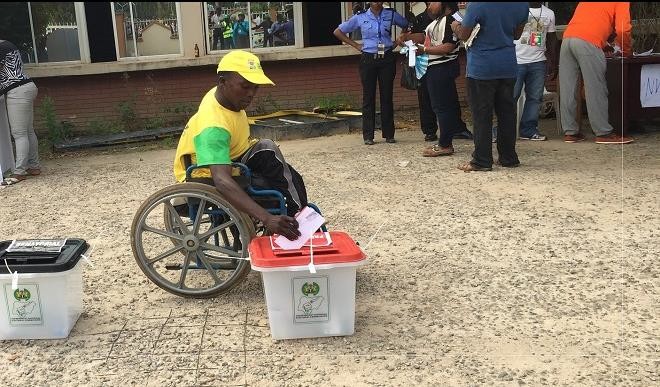
As preparations gather momentum for the August 15, 2026 governorship election in Osun State, the Independent National Electoral Commission (INEC) has reiterated its commitment to ensuring that Persons with Disabilities (PWDs) are not excluded from the electoral process, renewing focus on the gap between policy guarantees and actual access to voting.
The Resident Electoral Commissioner in the state, Dr. Mutiu Agboke, made this known in Osogbo during a sensitisation and awareness programme organised by INEC headquarters, Abuja, centred on the devolution of the Continuous Voter Registration (CVR) exercise to registration areas. The initiative, which moves registration activities from local government offices to the ward level, is designed to reduce structural and mobility barriers that have historically limited participation among marginalised groups, particularly PWDs.
Agboke said the decentralisation would bring registration closer to communities, enabling first-time voters who have attained the age of 18 to enrol more easily, while also allowing existing voters to transfer or update their details without the burden of long-distance travel. He maintained that inclusive participation is fundamental to democratic legitimacy, stressing that the disability community remains an integral part of Nigeria’s electoral system.
Beyond registration, the Commission outlined a series of assistive measures intended to support PWDs on election day, including the deployment of Braille ballot guides, magnifying glasses, and large-print materials, as well as priority voting arrangements at polling units. INEC also indicated that trained personnel would be available to provide assistance where required, alongside the use of designated forms to capture data and support voters who may need help.
While these commitments reflect alignment with existing frameworks on inclusive elections, concerns persist around implementation, as previous electoral cycles have exposed gaps between provisions on paper and the realities at polling units. Issues such as inaccessible voting locations, inconsistent deployment of assistive materials, and limited capacity of ad hoc staff have continued to constrain effective participation for many PWDs.
Stakeholders at the engagement acknowledged the significance of the initiative but emphasised the need for accountability and sustained execution. The Osun State Director of the National Orientation Agency, Adebiyi Adefarasin Stephen, described the effort as timely, noting that meaningful inclusion requires deliberate institutional action.
Similarly, the Chairman of the Joint National Association of Persons with Disabilities (JONAPWD) in Osun State, Steven Oluwakemi, commended INEC’s steps while calling for expanded accessibility measures, adequate resourcing, and continuous training of electoral officials.
Oluwakemi reiterated that voting is a fundamental right rather than a privilege and urged the Commission to ensure that its commitments translate into measurable improvements in voter experience. He added that the disability community remains open to collaboration with INEC to strengthen inclusive practices and advance a barrier-free electoral environment in the state.
As the election approaches, the effectiveness of these interventions will serve as a critical test of the Commission’s commitment to inclusion, with the credibility of the process increasingly tied to whether all eligible voters, including PWDs, can participate without hindrance.
