
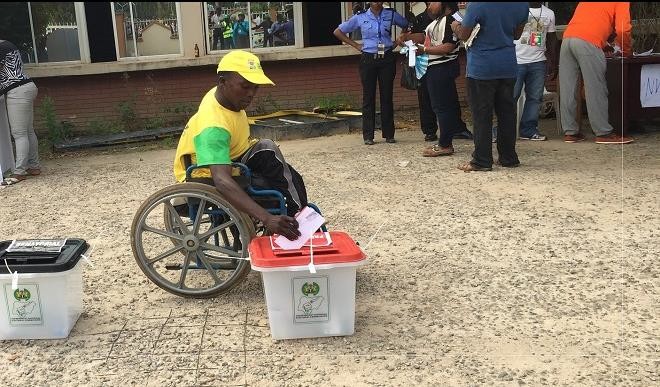
The Gombe State Commission for Persons with Disabilities (GSCPWD), in collaboration with the Independent National Electoral Commission (INEC), has announced a three-day special voter registration exercise aimed at increasing the political participation of Persons with Disabilities (PWDs) ahead of the 2027 General Elections.
The exercise will take place from Monday, June 29 to Wednesday, July 1, 2026, between 9:00 a.m. and 3:00 p.m. daily at the Commission’s Temporary Office located within the High Court Premises, Tudun Wada, Gombe.
According to the Commission, the initiative is designed to provide a safe, accessible, and disability-friendly environment where eligible persons with disabilities can register as new voters, transfer their voter registration, update their details, or resolve issues relating to their Permanent Voter Cards (PVCs).
The Executive Chairman of the Gombe State Commission for Persons with Disabilities, Adamu Ishaq, called on all eligible persons with disabilities in Gombe metropolis and surrounding communities to seize the opportunity to register or regularise their voter records in preparation for the 2027 elections.
He also directed chairpersons of disability cluster associations across the state to mobilise their members for the exercise, assuring them that he would personally monitor the registration process to ensure its success. He further encouraged persons with disabilities residing in other local government areas to visit their respective INEC registration centres to register or address any voter registration challenges.
The Commission expressed appreciation to the Resident Electoral Commissioner of INEC in Gombe State for supporting the disability-inclusive initiative and commended the Head of Voter Education and Publicity, Rifkatu Dukku, for strengthening awareness of the Continuous Voter Registration (CVR) exercise within the disability community.
Describing INEC Gombe’s disability-inclusive approach as commendable, the Commission said the initiative demonstrates that electoral participation can be made accessible when institutions intentionally remove barriers faced by persons with disabilities.
The Commission urged all eligible persons with disabilities to participate in the exercise, stressing that every vote matters and that no one should be left behind in Nigeria’s democratic process.
The initiative also provides an important example for other states across Nigeria. As preparations for the 2027 General Elections continue, state disability commissions and INEC offices nationwide should adopt similar disability-friendly voter registration exercises to ensure that persons with disabilities can participate fully in the electoral process without facing unnecessary physical, communication, or administrative barriers.
The development aligns with concerns previously raised by PWDSPOTLIGHT regarding the slow pace of disability inclusion in Nigeria. The report noted that nearly eight years after the enactment of the Discrimination Against Persons with Disabilities (Prohibition) Act, millions of Nigerians with disabilities continue to face inaccessible public infrastructure, exclusion from governance, education, employment, and other aspects of public life.
The report further argued that while Nigeria has progressive disability rights legislation, implementation remains weak, with accessibility often treated as optional rather than mandatory. It stressed that true inclusion requires deliberate action, stronger enforcement of disability laws, and the removal of barriers that prevent persons with disabilities from participating equally in society.
Against this backdrop, Gombe’s collaboration with INEC represents a practical step toward translating disability inclusion from policy into action. Initiatives such as this not only improve access to voter registration but also reinforce the constitutional right of persons with disabilities to participate fully in democratic governance. As Nigeria moves closer to the 2027 elections, disability-inclusive electoral processes should become the standard rather than the exception.
