

For thousands of children with disabilities in Nigeria, access to assistive technology remains one of the biggest barriers to education, mobility, communication and independent living. A new intervention by the Economic Community of West African States (ECOWAS) Commission seeks to change that reality.
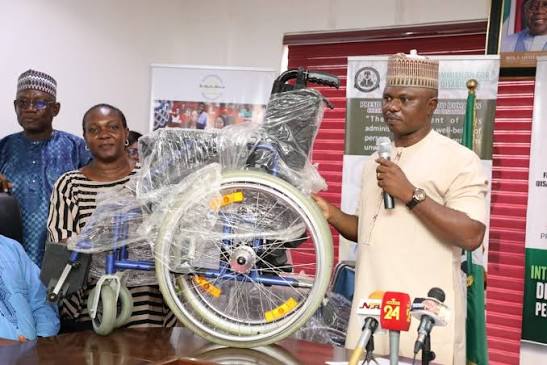
The National Commission for Persons with Disabilities (NCPWD) has received a consignment of assistive devices from the ECOWAS Commission under its Regional Programme for the Provision of Assistive Devices to Children with Disabilities in West Africa.
The devices were formally presented during a ceremony at the Commission’s headquarters in Abuja, bringing together representatives of government, development partners, Organisations of Persons with Disabilities (OPDs), rehabilitation professionals and disability advocates committed to advancing disability inclusion.
Receiving the donation, Executive Secretary of the NCPWD, Hon. Ayuba Burki Gufwan, described the initiative as a significant step toward ensuring that children with disabilities are not excluded from opportunities simply because they lack the tools they need to participate fully in society.
He noted that assistive technology goes beyond equipment, describing it as a gateway to education, confidence, independence and social participation.
Gufwan, however, stressed that the need remains enormous. Citing the World Health Organization (WHO) and UNICEF Global Report on Assistive Technology, he said nine out of every ten people worldwide who require assistive technology do not have access to it.
According to him, more than 26 million persons with disabilities in Nigeria require one form of assistive technology or another, underscoring the urgent need for increased investment, stronger partnerships and sustainable access programmes.
He called on governments, development agencies, civil society organisations, the private sector and disability groups to work together to bridge the gap, while encouraging caregivers, teachers and rehabilitation professionals to ensure that assistive devices are properly used and maintained.
Representing the Minister of Humanitarian Affairs and Poverty Reduction, Senior Technical Adviser on Humanitarian Affairs, Hon. Daniel Dung Dalyop, described the donation as more than a humanitarian gesture.
He said the intervention aligns with the Federal Government’s broader commitment to social protection, poverty reduction and the rights of persons with disabilities.
Dalyop observed that many of the challenges experienced by persons with disabilities arise not from their impairments but from inadequate societal support and inaccessible environments.
He urged the NCPWD to ensure that the donated devices reach children who need them most through a transparent and equitable distribution process, while encouraging development partners to expand investments in disability-inclusive programmes across Nigeria.
Speaking on behalf of the ECOWAS Commission, Commissioner for Human Development and Social Affairs, Prof. Fatou Sow Sarr, said the regional programme was developed following a 2024 disability inclusion assessment that revealed critical shortages in access to assistive technology across West Africa.
She explained that children with disabilities remain among the region’s most underserved populations, making access to mobility, communication and learning aids a priority under the ECOWAS Vision 2050 agenda.
Prof. Sarr disclosed that an estimated 240 million children globally live with disabilities, while approximately 15 per cent of children between the ages of zero and 17 in West and Central Africa have one form of disability.
She said the initiative also supports the principles of the United Nations Convention on the Rights of Persons with Disabilities (UNCRPD), which promotes accessibility, inclusion and equal participation.
ECOWAS officials revealed that Nigeria and Togo are the first beneficiaries of the regional initiative, with plans already underway to expand support to other member states.
Future priorities, they said, include improving disability data collection, encouraging local production of assistive technology through strategic partnerships and strengthening national systems that support access to assistive devices.
Also speaking, the Senior Special Assistant to the President on Special Needs and Equal Opportunities, Hon. Mohammed Abba Isa, commended ECOWAS for its continued commitment to disability inclusion in the region.
He reaffirmed the commitment of the President Bola Tinubu administration to implementing the Discrimination Against Persons with Disabilities (Prohibition) Act, 2018, while applauding the NCPWD for building partnerships that improve the lives of persons with disabilities.
The event also featured the official presentation of the assistive devices to the NCPWD and the unveiling of the Commission’s User Guide on Assistive Technology by Dr. Ismail Idris, Head of the Assistive Devices and Technology Unit.
