
The National Commission for Persons with Disabilities (NCPWD) has called for stronger collaboration with the Nigeria Partnership for Disability-Inclusive Development (NIPDID) to address persistent barriers confronting Persons with Disabilities (PWDs) and accelerate disability-inclusive development across Nigeria.
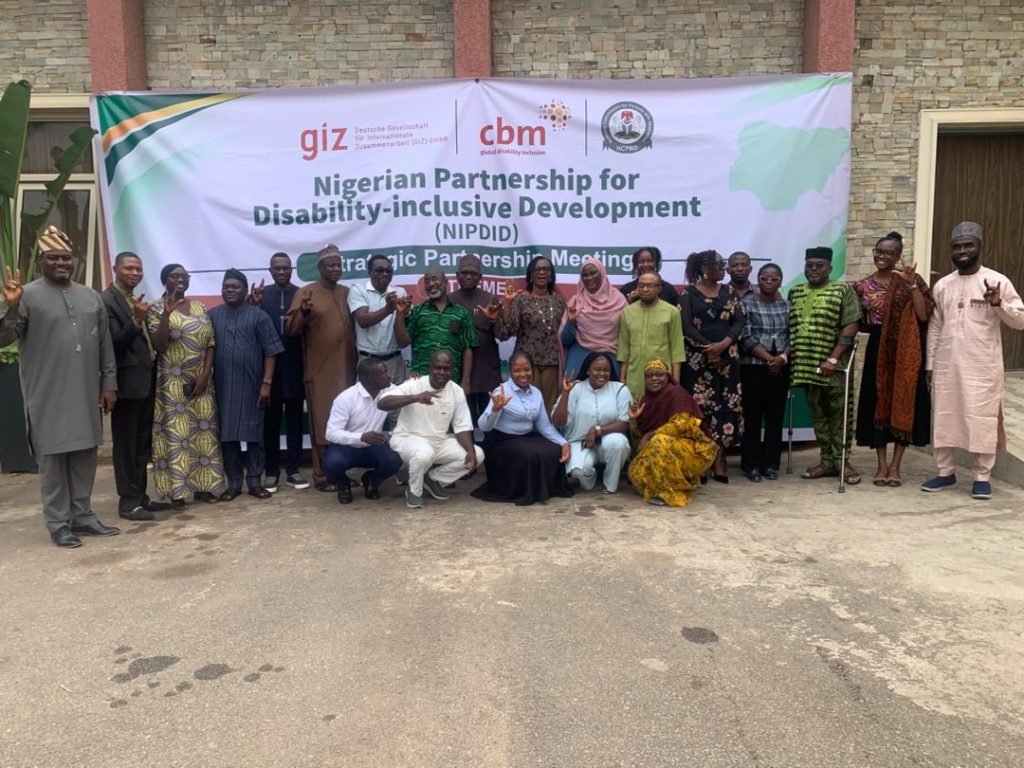
The Executive Secretary of NCPWD, Hon. Ayuba Burki Gufwan, made the call at a one-day NIPDID Strategic Meeting held on Tuesday, November 10, 2026, in Abuja. He was represented at the meeting by the Director of Social Integration, Lawrence Idemudia.
Gufwan acknowledged that Nigeria had made progress in advancing disability rights since the enactment of the Discrimination Against Persons with Disabilities (Prohibition) Act, 2018. However, he noted that significant gaps in implementation continue to limit the impact of the legislation, particularly in education, healthcare, employment, accessibility, social protection, political participation and access to justice.
He identified inadequate disability-disaggregated data, weak institutional capacity, insufficient funding and poor accountability mechanisms as some of the major obstacles undermining the effective implementation of disability-inclusive policies and programmes.
According to him, the existence of legislation, policies and institutional structures does not automatically translate into improved living conditions for PWDs, stressing the need for coordinated action among government institutions, development partners, Organisations of Persons with Disabilities (OPDs), civil society organisations and other relevant stakeholders.
The NCPWD Executive Secretary commended NIPDID for reviewing its achievements and repositioning itself to deliver greater impact. He described the proposed 2027–2030 Strategic Partnership Framework as an opportunity to move beyond information sharing towards strategic coordination, aligned investments, joint initiatives and collective accountability.
He urged stakeholders to identify practical areas of collaboration for the remaining months of 2026 while laying a solid foundation for the implementation of the new framework from 2027.
Gufwan also called on participants to ensure that their discussions produced practical solutions, clearly defined responsibilities and measurable commitments capable of advancing the rights, dignity, opportunities and quality of life of PWDs across the country.
Earlier, the representative of Sightsavers, Esther Bature, provided an overview of NIPDID’s establishment, explaining that the partnership emerged in 2021 through the collaboration of three development partners: the World Bank, Sightsavers and the Foreign, Commonwealth and Development Office (FCDO). The platform commenced full operations in September 2022.
She explained that NIPDID had helped streamline the activities of development partners by providing a common platform for coordination, knowledge exchange and collaboration, thereby reducing duplication of interventions.
However, she emphasised that sustained collaboration remained necessary to address persistent challenges, including exclusion, institutional capacity limitations and the absence of reliable disability data for effective planning and programme implementation.
Representatives of Christian Blind Mission (CBM) Global and the World Bank, in their separate remarks, also underscored the importance of effective participation, fairness and collective responsibility in achieving meaningful progress in disability inclusion.
Providing an overview of the partnership’s development, the meeting facilitator, Dr. Adebukola Adebayo, highlighted NIPDID’s journey, from its establishment in 2022 and platform development in 2023 to the changing operational context in 2025 and its strategic reflection in 2026.
He outlined key priorities for advancing disability inclusion in Nigeria, including enforcing accessibility standards, expanding employment opportunities for PWDs, strengthening disability inclusion at the state level and mainstreaming disability considerations across development programmes.
Other priorities identified include improving disability data systems, intensifying advocacy and public sensitisation, and promoting education and research to strengthen evidence-based policymaking and programme delivery.
Since its establishment, NIPDID has provided a collaborative platform for international development partners to exchange knowledge, strengthen partnerships, coordinate development assistance and advance disability-inclusive development in Nigeria.
A major outcome of the meeting was the establishment of a committee to guide the finalisation and adoption of NIPDID’s four-year Strategic Partnership Framework, which is expected to provide direction for its activities and collaborative priorities between 2027 and 2030.
The meeting was held under the theme, “Strengthening Strategic Partnership for Accelerated Disability-Inclusive Development in Nigeria: Conceptualising a New NIPDID Strategic Partnership Framework (SPF) and Defining Joint Priorities with the National Commission for Persons with Disabilities.”
The proposed framework is expected to strengthen coordination among stakeholders and promote more deliberate, measurable and sustainable interventions towards removing barriers and expanding opportunities for Persons with Disabilities in Nigeria.
