
BY: Mustapha Lawal
The struggle for inclusion in Nigeria’s oil-producing communities is not only about environmental justice or access to economic opportunities. For many persons with disabilities (PWDs) in the Niger Delta, it is also about visibility, representation, and the right to participate in decisions that shape their lives.
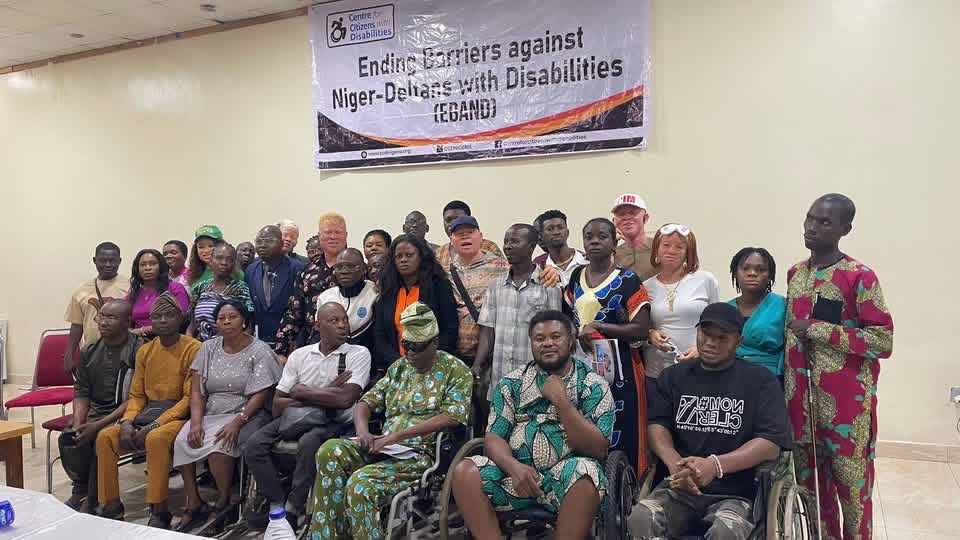
It was against this backdrop that the Centre for Citizens with Disabilities (CCD) convened a two-day advocacy and capacity-building workshop in Ondo State under its Ending Barriers Against Niger-Deltans with Disabilities (EBAND) project, bringing together PWDs from oil-producing communities, government officials, Organisations of Persons with Disabilities (OPDs), and media practitioners to strengthen disability advocacy and deepen understanding of the Petroleum Industry Act (PIA) 2021.
The workshop focused on a growing concern among disability advocates: despite the establishment of governance and benefit-sharing structures for host communities under the PIA, persons with disabilities remain largely excluded from participation and decision-making processes.
Delivering the welcome remarks on behalf of CCD’s Founding Executive Director, David Obinna Anyaele, and the Acting Director, Mr. Godwin Unumeri, Mrs. Florence Austin emphasized that inclusion must move beyond rhetoric to practical representation within community governance systems.
According to her, although the Niger Delta contributes immensely to Nigeria’s economic survival through oil production, many PWDs within host communities continue to experience marginalisation, exclusion from leadership structures, and limited access to development opportunities.
She described disability inclusion as a matter of rights and justice rather than charity, referencing the Discrimination Against Persons with Disabilities (Prohibition) Act 2018 and the United Nations Convention on the Rights of Persons with Disabilities (UNCRPD) as important legal frameworks protecting the rights of persons with disabilities in Nigeria.
Austin also reflected on the journey of CCD, explaining that the organisation was founded in 2002 following the experiences of its founder during the Sierra Leone civil war. What began as support for amputees through the Amputation Rehabilitation Centre, she noted, has evolved into a broader movement advancing the rights, dignity, and inclusion of all persons with disabilities across Nigeria.
Speaking during the workshop, the Chairman of the Joint National Association of Persons with Disabilities (JONAPWD) in Ondo State, Comrade Abiodun Samuel Olusegun, commended CCD for creating a platform that educates and empowers PWDs on their rights under the Petroleum Industry Act.
While acknowledging the importance of the law in regulating oil-related activities within host communities, Olusegun observed that disability concerns remain insufficiently addressed within its framework.
He expressed hope that provisions similar to those contained in the Disability Act, particularly the five per cent employment quota for persons with disabilities, would eventually be integrated into the PIA structure to guarantee equitable participation and inclusion.
In her goodwill message, Princess Arise Folasade Comfort, Board Chairman of the Ondo State Disability Commission, described CCD as her “first home,” acknowledging the organisation’s role in shaping her personal and professional growth within the disability rights movement.
She praised David Anyaele for his longstanding commitment to disability advocacy and commended CCD for sustaining impactful programmes that continue to amplify the voices of persons with disabilities in Ondo State and beyond.
The workshop sessions explored the intersection between disability, environmental vulnerability, and oil exploration within the Niger Delta. Participants examined the impact of pollution, poor infrastructure, communication barriers, and systemic exclusion on the lives of persons with disabilities living in host communities.
Discussions also focused on the Petroleum Industry Act and the structure of the Host Community Development Trusts (HCDTs), highlighting the governance gaps that continue to exclude PWDs from benefit-sharing and community leadership processes.
For many participants, the conversations went beyond policy analysis. They became an opportunity to share lived experiences of discrimination, exclusion from leadership spaces, and limited access to information and community resources.
The second day of the workshop shifted toward practical advocacy strategies and inclusive governance approaches. Sessions addressed stakeholder engagement, advocacy planning, leadership development, inclusive budgeting, and pathways for integrating disability concerns into community development plans.
Through interactive discussions and role-play exercises, participants explored practical methods for engaging traditional rulers, government agencies, oil companies, and community leaders to secure representation for persons with disabilities within Host Community Development Trusts, Boards of Trustees, and Advisory Committees.
By the end of the workshop, participants expressed renewed confidence in their ability to advocate for inclusion within their communities. Many pledged to strengthen advocacy networks, engage relevant stakeholders, and share the knowledge gained with other members of the disability community.
Beyond the training sessions and discussions, the workshop underscored a broader reality: true inclusion within the Niger Delta cannot be achieved if persons with disabilities remain absent from the structures responsible for governance, development, and resource distribution.
As conversations around host community development and oil sector reforms continue, disability advocates say inclusion must not exist only within policy documents but also within the lived realities of the people those policies are meant to serve.
For participants in Ondo, the workshop represented more than a capacity-building exercise. It was another step toward building a disability movement that is informed, empowered, and determined to ensure that no one is left behind in the pursuit of development and justice in the Niger Delta.
