

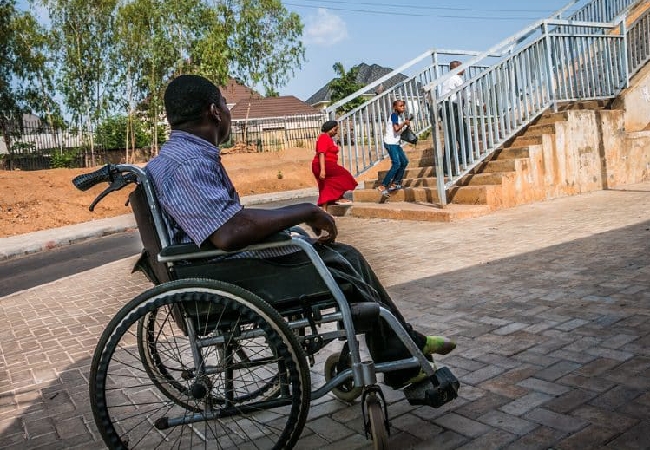
The Federal High Court in Abuja has adjourned the hearing of a ₦66 trillion disability rights class-action suit seeking judicial recognition and stronger legal protection for people living with long-term trauma-related psychiatric and psychosocial impairments.
The case, FHC/ABJ/CS/1824/2026, was adjourned by Justice Joyce Abdulmalik to Wednesday, September 9, 2026, following proceedings on Monday.
The development comes days after PWD Spotlight reported the filing of the suit by disability rights advocates against the Federal Government and 25 other institutions over alleged decades of systemic neglect, discrimination and exclusion of persons with disabilities.
In the original suit, the applicants are seeking ₦66 trillion in general, structural and punitive damages, calculated at ₦1 trillion for each year of alleged state neglect since Nigeria gained independence in 1960. The claims remain before the court and have not been awarded.
Applicants seek recognition of trauma-related disabilities
A major issue now before the court is the applicants’ request for formal recognition of long-term psychiatric and psychosocial impairments, particularly trauma-related conditions, as disabilities protected under Nigeria’s Discrimination Against Persons with Disabilities (Prohibition) Act, 2018, and the United Nations Convention on the Rights of Persons with Disabilities (CRPD).
The applicants cited clinical studies involving Almajiri children, street-exposed youths and traditional Tsangaya pupils, arguing that significant levels of psychiatric and trauma-related conditions exist among vulnerable populations but have not received adequate disability-specific protection.
They further identified groups including internally displaced persons and combat veterans as populations that may require specialised medical care, rehabilitation, protection and representation where long-term psychological trauma results in disabling conditions.
The applicants argue that the failure to address such conditions has implications not only for disability rights but also for public health, national development and security.
Fresh challenge to proposed JONAPWD election
The suit has also taken on a new dimension with an application seeking to stop the proposed national convention and election of the Joint National Association of Persons with Disabilities (JONAPWD) scheduled for October 18–21, 2026, in Kaduna.
The applicants are asking the Federal High Court for an emergency order restraining the planned election pending the determination of the substantive issues before the court.
According to their filings, the proposed election is being organised under the 2011/2014 JONAPWD Constitution, which they contend was declared legally ineffective in a 2023 judgment of the High Court of Cross River State.
They maintain that the 2008 JONAPWD Constitution registered with the Corporate Affairs Commission remains the valid governing document of the association.
The dispute over JONAPWD’s governance is part of the wider institutional questions raised in the lawsuit. PWD Spotlight’s earlier report noted that the applicants had also sought judicial intervention over alleged unauthorised conventions and elections within the disability movement.
Applicants demand wider institutional reforms
Beyond the ₦66 trillion damages claim and the dispute over the proposed JONAPWD election, the applicants are asking the court to order broad reforms in the way disability affairs are administered across Nigeria.
Among the reliefs being sought is a forensic audit of public and international funds allocated to disability affairs, alongside investigations into the management and alleged diversion of disability intervention funds.
They are also seeking restructuring of disability institutions and the establishment of adequately funded disability implementation structures across Nigeria’s 36 states and 774 local government areas.
The applicants say such structures are necessary to ensure that disability laws and policies move beyond formal recognition to actual implementation.
‘We have been patient for 27 years’
Speaking on the case, Lady Omotunde Ellen Thompson, Life-Chairperson of the JONAPWD National Board of Trustees, said the applicants had spent decades documenting the issues now before the court.
“We have been patient for twenty-seven years. We built the record and the clinical studies, the court judgment, the treaty text, and we are asking this Court to apply Nigeria’s own laws to populations the law was always written to protect.”
Also speaking, Chief Eric Ndubueze Ufom, President/CEO of Equal Rights for Persons with Disabilities International, said the case was founded on the definition of disability contained in the UN Convention.
“The definition of disability we fought for was deliberately written to include exactly this kind of long-term psychiatric harm,”
Ufom said the action was intended to compel Nigeria to fulfil its obligations under the international treaty.
‘Nothing About Us Without Us’
The applicants have also reiterated the importance of direct participation by persons with disabilities in decisions affecting their lives.
They invoked the principle of “Nothing About Us Without Us,” arguing that organisations representing persons with disabilities should be involved in the design and implementation of government policies and programmes concerning disability.
They contend that meaningful participation is necessary if government interventions are to reflect the actual experiences and needs of persons with disabilities.
Next hearing
The case will return before the Federal High Court in Abuja on Wednesday, September 9, 2026, at 9:00 a.m., at Federal Court House 7, Abuja.
The applicants’ claims, including the ₦66 trillion damages demand, allegations concerning disability governance and the issues surrounding the JONAPWD constitution and proposed election, remain subject to judicial determination.
Read the earlier PWD Spotlight report: PWDs Sue Federal Government, 25 Institutions for N66 Trillion Over Alleged Systemic Neglect.
