

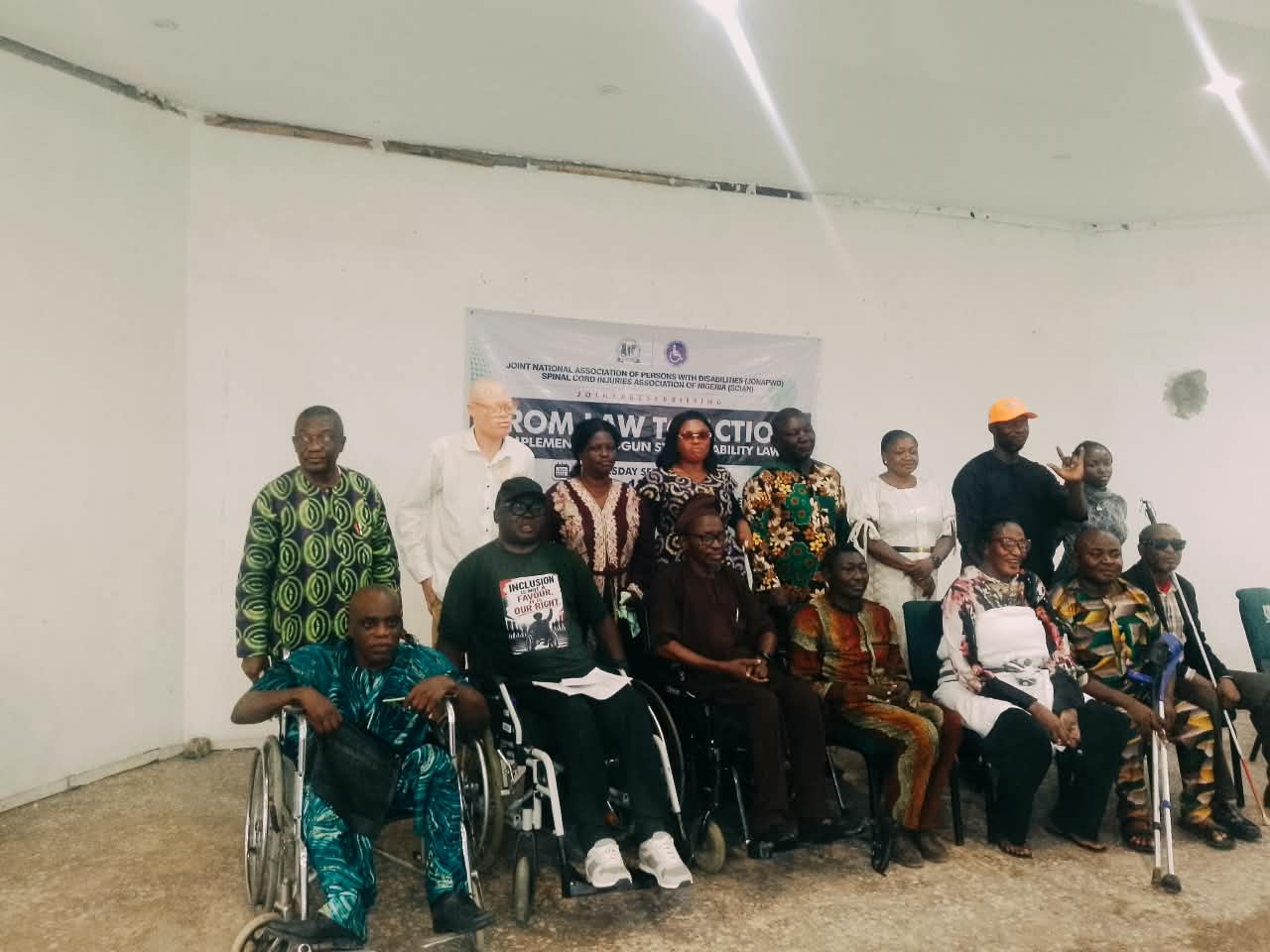
ABEOKUTA — Nearly nine years after the Ogun State Disability Law was assented to, disability organisations in the state have renewed calls for its full implementation, saying the continued gap between legislation and action is leaving persons with disabilities without the institutional protections guaranteed by law.
The Joint National Association of Persons with Disabilities (JONAPWD) and the Spinal Cord Injuries Association of Nigeria (SCIAN) made the demand on Wednesday at a joint press briefing held at the Nigeria Union of Journalists (NUJ) Secretariat in Abeokuta.
The briefing, held under the theme “From Law to Action: Implement the Ogun State Disability Law,” was supported by the Disability Rights Fund.
The organisations said the law, signed into law on December 27, 2017, has yet to produce the institutional structures, enforcement mechanisms and accessible systems required to give practical effect to the rights of persons with disabilities across the state.
Speaking on behalf of the organisations, SCIAN National President, Abdulwahab Matepo, said the disability community had spent years pursuing dialogue with government institutions and other stakeholders in the hope of resolving the implementation challenges.
He said the prolonged consultations should now give way to measurable action.
“Almost nine years after the law was assented to, persons with disabilities in Ogun State are still waiting to see the legal framework translated into functioning institutions,” Matepo said.
The latest demand follows a series of advocacy efforts by disability organisations seeking the establishment of a functional institutional framework for disability affairs in Ogun State.
In December 2025, disability advocates called for the gazetting or re-enactment of the law, the establishment of a state disability commission and the creation of a dedicated budget line for disability affairs.
The groups said the urgency of the matter was underscored by the number of people potentially affected by the absence of effective implementation.
JONAPWD’s 2025 estimate puts the number of persons with disabilities in Ogun State at approximately 1,032,221. The organisation, however, has clarified that the figure is an assumptive estimate rather than the outcome of a dedicated population census, having been derived by applying a disability benchmark to National Population Commission population projections.
The organisations said regardless of the precise population figure, the issue affects people whose access to education, healthcare, employment, transportation, public infrastructure, political participation and economic opportunities depends on the removal of disability-related barriers.
At the global level, the World Health Organisation estimates that approximately 1.3 billion people, representing about 16 per cent of the world’s population, experience significant disability.
From consultation to implementation
Matepo said JONAPWD and SCIAN had engaged the Ogun State House of Assembly, Ministry of Justice, Ministry of Women Affairs and Social Development, traditional institutions and other stakeholders over the implementation of the law.
The organisations have also participated in discussions on possible amendments to the legislation following concerns about provisions considered inadequate or difficult to implement.
A stakeholder consultation was held in April 2026 to consider the way forward. Further engagements with government officials continued afterwards.
According to Matepo, one of the significant engagements took place on June 9, 2026, when representatives of the disability community met with the Ogun State Attorney-General and Commissioner for Justice, Oluwasina Olanrewaju Ogungbade, SAN.
Matepo said the Attorney-General assured the delegation that he would work on the matter and provide an update within two weeks.
The disability organisations said they deliberately refrained from immediately escalating the matter publicly, allowing time for the promised intervention. They subsequently followed up through correspondence and additional engagements.
A report following the June meeting also stated that Ogungbade had pledged urgent steps towards addressing the implementation challenge.
Despite these engagements, the organisations said the absence of visible institutional action remained a concern.
‘This is about rights, not charity’
Ogun JONAPWD Chairman, Ayo Awobona, said the advocacy was not intended as a confrontation with the state government but as an effort to secure concrete action on an issue affecting the rights of citizens.
Awobona acknowledged the government officials who had made themselves available for dialogue but said the success of advocacy should ultimately be determined by what changes occur beyond meetings and assurances.
“We have continued to engage and not confront the Ogun State Government, but advocacy must ultimately be measured by outcomes,” he said.
He stressed that disability inclusion should be understood as a question of rights, dignity, equality, accessibility, participation and citizenship rather than charity.
According to him, persons with disabilities are active members of society who contribute to the economy, raise families, operate businesses, work in public and private institutions and participate in education, politics, sports and community development.
The organisations also responded to concerns that the existing legislation may require amendment before full implementation.
They said they were open to legislative review and had already submitted proposals addressing identified gaps in the law.
However, they argued that an amendment process should not become an indefinite reason for delaying action.
Their position is that the existing framework should be operationalised in accordance with applicable legal procedures while necessary amendments proceed through the appropriate legislative process.
Such an approach, they said, would enable the state to begin addressing immediate institutional and administrative needs while working to improve the legislation.
Impact extends beyond the disability community
The groups said the consequences of delayed implementation could be seen in several areas of everyday life, including access to public buildings and services, inclusive education, healthcare, transportation, employment and economic opportunities.
They also highlighted protection against discrimination and harmful practices, as well as participation in political and civic life.
The organisations said their radio advocacy campaign between August and September had focused on these issues and sought to increase public understanding of the barriers faced by persons with disabilities.
They argued that disability inclusion should not be treated as an issue affecting only people with disabilities.
An inaccessible school, for instance, can prevent a child from receiving an education, while an inaccessible hospital can prevent a patient from obtaining healthcare. Inaccessible transport systems can similarly restrict workers, students and other members of the public.
The groups therefore called for disability inclusion to be integrated into broader state planning and public service delivery.
Appeal to Abiodun and 2027 candidates
The organisations appealed to Ogun State Governor, Dapo Abiodun, to provide political direction towards concluding the implementation process before the end of his administration.
They urged the governor to direct relevant government institutions to take concrete steps towards operationalising the Disability Law and establishing the institutional mechanisms necessary for enforcing disability rights.
They said such action would help ensure that persons with disabilities do not have to begin the same advocacy process from the beginning whenever there is a change of administration.
The organisations also looked beyond the current administration, calling on political parties and governorship candidates ahead of the 2027 Ogun State governorship election to make disability inclusion part of their policy agendas.
They urged candidates to publicly state their positions on implementation of the Disability Law and engage directly with persons with disabilities on their plans for inclusive governance.
The groups emphasised that the campaign was non-partisan and that their demand was directed at whoever receives the mandate to govern the state.
They also called on the Independent National Electoral Commission (INEC) to ensure that the 2027 electoral process is accessible to persons with disabilities, including through accessible polling locations, voting materials and appropriate assistance where required.
According to the organisations, persons with disabilities must be able to participate fully in elections and other democratic processes without physical or institutional barriers.
‘From law on paper to law in action’
Concluding the briefing, Matepo and Awobona said the disability community had demonstrated patience through years of letters, meetings, consultations, courtesy visits, legal engagements and public awareness campaigns.
They maintained that the time had come for the government to move beyond continued consultation towards implementation.
For the disability community, they said, the central question is no longer whether disability rights should be recognised in law, but whether those rights can be experienced in everyday life.
The organisations therefore called on the Ogun State Government to move “from consultation to commitment, commitment to action, and from a law on paper to a law that operates in the daily lives of persons with disabilities.”
