

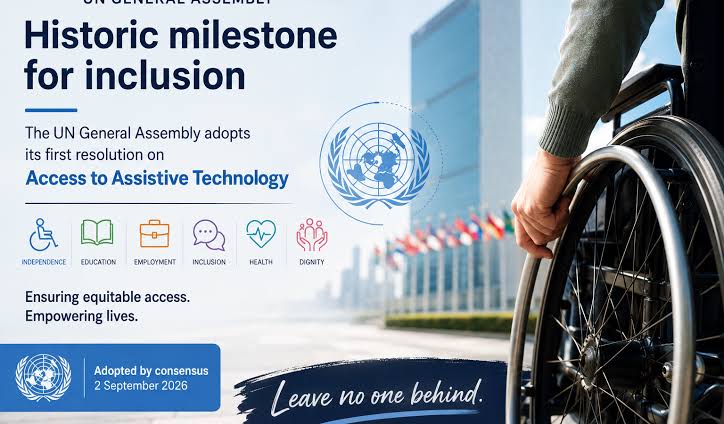
The National Commission for Persons with Disabilities (NCPWD) has welcomed the United Nations General Assembly resolution aimed at improving access to assistive technology, describing it as a major step towards advancing disability inclusion, equality and independent living globally.
The resolution, presented by Pakistan and co-sponsored by more than 40 UN Member States, was adopted by consensus on September 2, 2026.
It recognizes assistive technology as an essential part of sustainable development, universal health coverage and the realization of the rights of Persons with Disabilities (PWDs) and older persons.
Assistive Technology Is a Necessity, Not a Luxury
Reacting to the resolution, NCPWD Executive Secretary, Hon. Ayuba Gufwan, stressed that assistive technology must be treated as an essential tool for participation and independence rather than a luxury.
“Assistive technology is not a luxury. It is an essential enabler of participation and independent living,” Gufwan said.
He pointed to wheelchairs, hearing aids, screen readers and prosthetic devices as examples of technologies that enable people with disabilities to access education, employment, healthcare, communication and community life.
For many PWDs, the availability of the right assistive device can determine whether they can attend school, secure employment, access healthcare or participate independently in their communities.
Nigeria Faces Critical Access Challenges
Gufwan said the UN resolution is particularly significant for Nigeria, where access to appropriate, affordable and quality-assured assistive technology remains a critical issue.
He called for stronger efforts to integrate assistive technology into the country’s health, education, labour and social protection systems.
According to him, achieving meaningful access will require sustainable financing, increased local production, innovation, specialized personnel and more efficient supply chains.
Better Data and Innovation Needed
The NCPWD Executive Secretary also emphasised the importance of improving data collection and research on assistive technology needs in Nigeria.
Reliable data, he noted, would help policymakers better understand the needs of different disability groups and develop evidence-based programmes and interventions.
He further called for stronger collaboration between government institutions, development partners, universities, manufacturers, rehabilitation professionals and Organizations of Persons with Disabilities (OPDs).
Such partnerships, he said, would be essential to expanding access to appropriate assistive technology across Nigeria’s 36 states and the Federal Capital Territory.
NCPWD Reaffirms Commitment
Gufwan reaffirmed the Commission’s commitment to promoting policies, partnerships and programmes that advance access to assistive technology for Nigerians with disabilities.
“This UN resolution gives us renewed momentum. NCPWD will continue to champion policies, partnerships and programmes that ensure no Nigerian is left behind because of lack of access to the right assistive device,” he said.
The UN resolution represents an important global push towards making assistive technology more accessible and affordable. For Nigeria, its significance will ultimately depend on translating the commitment into concrete action—including stronger financing, local manufacturing, effective distribution and meaningful involvement of PWDs in decision-making.
For Persons with Disabilities, access to the right assistive technology is not simply about having a device. It is about having the opportunity to learn, work, communicate, move freely and live independently.
