

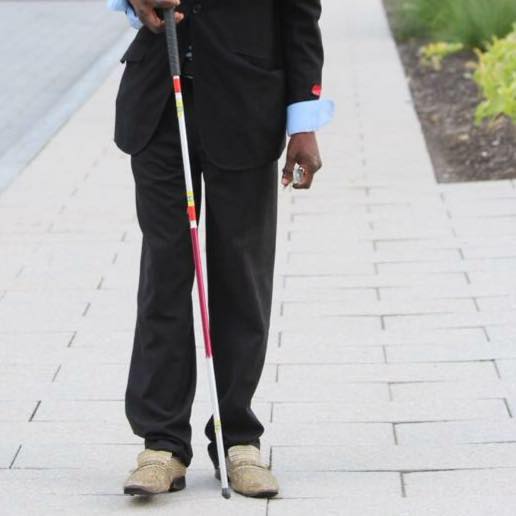
People with visual impairments have called on governments, financial institutions, and other stakeholders to dismantle structural barriers that limit their independence and to provide accessible roads, inclusive digital financial services, and sustainable economic opportunities.
The call was made on Friday, October 23, in Abeokuta, Ogun State, during the 2026 International White Cane Safety Day and Empowerment Programme organised by the Nigeria Association of the Blind (NAB), Abeokuta South Chapter.
The programme, themed “Knights of the Blind in the Modern Era: Championing Mobility, Digital Financial Access, and Livelihood Inclusion for Persons with Visual Impairments,” brought together disability rights advocates, legal practitioners, members of the association, and other stakeholders to discuss barriers confronting persons with visual impairments.
A notable highlight of the programme was the handover of 50 white canes by the Lions Club’s Vision & Sight Abeokuta Axis, District 404B-4 Nigeria, as part of efforts to support the mobility and independence of persons with visual impairments, handed over to the Chairperson of the NAB Abeokuta South Chapter, Oluwatomisi Adeyefa Olatayo, by Lion Mumeen Akintola Akinsanya, NLCF.
The donation provided practical support for white cane users while reinforcing the importance of ensuring that persons with visual impairments have access to mobility aids and the environmental conditions necessary to use them safely. The Beyond Limit Women and Girls Initiative also provided venue logistics and livelihood support for four members who had been steadfast in the activities of the association, with items like blenders, irons, and an electric kettle, among others.
In his keynote address, human rights specialist and disability rights advocate, Olayinka Salam Komolafe, argued that the principal challenge facing visually impaired Nigerians was not blindness itself but the institutional and environmental barriers that restrict their independence and participation in society.
“The real darkness in Nigeria is not blindness—it is the systemic barriers that turn blindness into a disability,” Komolafe said, highlighting the need to move beyond the distribution of mobility aids towards creating environments that enable persons with visual impairments to navigate public spaces and access essential services independently.
Komolafe criticised the condition of pedestrian infrastructure, arguing that providing white canes without safe walkways, tactile paving, accessible traffic signals and adequate orientation and mobility training would not sufficiently address the challenges faced by blind and visually impaired people.
He referenced Section 5 of the Discrimination Against Persons with Disabilities (Prohibition) Act, 2018, which addresses accessibility in public buildings and infrastructure, including pedestrian walkways, and called for stronger implementation of existing disability rights provisions.
The concerns echo longstanding calls by disability advocates for accessible infrastructure that allows persons with visual impairments to travel safely without depending unnecessarily on other people.
The donation of 50 white canes added a practical dimension to these calls, demonstrating the role that civil society organisations and community-based initiatives can play in supporting persons with disabilities. However, the intervention also underscores the need for sustained efforts to ensure that mobility aids are complemented by accessible infrastructure, appropriate training and inclusive public services.
During the programme, participants also highlighted barriers in digital financial services, particularly banking applications and automated teller machines that lack adequate accessibility features. Komolafe warned that inaccessible banking systems could force visually impaired customers to depend on others to complete financial transactions, potentially compromising their privacy and financial security.
He urged commercial banks to make their digital platforms accessible, provide appropriate assistive technology and train employees to serve customers with disabilities professionally.
On economic empowerment, the keynote speaker called for expanded access to vocational training, business financing and sustainable livelihood programmes, stressing that meaningful inclusion must enable persons with visual impairments to earn a living and participate independently in economic life.
The Chairperson of the NAB Abeokuta South Chapter, Oluwatomisi Adeyefa Olatayo, similarly called for equal opportunities, inclusion in decision-making and support that enables persons with visual impairments to pursue education, employment and other livelihood opportunities.
She urged the public to move away from treating persons with disabilities as objects of pity, emphasising that they needed opportunities to become self-reliant and participate fully in society.
Disability rights are human rights, she said, calling for genuine support that addresses discrimination and stigma rather than relying solely on temporary donations.
The programme also featured a sensitisation walk along the Panseke Motor Park–Omida Market–Oke-Ilewo route to educate motorists, commercial transport operators and pedestrians about road safety and the rights of white cane users. Other activities included provisions for eye screening, eyeglasses, mobility canes, and economic empowerment initiatives.
These interventions reflect the dual importance of immediate assistance and long-term structural reform. While mobility aids can improve independent movement, their benefits are limited when pedestrians encounter obstructed walkways, unsafe road crossings, and public spaces that fail to accommodate their needs.
The National Commission for Persons with Disabilities (NCPWD) also reaffirmed this message in its statement marking the 2026 International White Cane Safety Day on October 15.
The Commission’s Executive Secretary, Ayuba Burki Gufwan, described the white cane as a symbol of independence, dignity and the right of blind persons to move freely, access education, pursue livelihoods and participate fully in society.
He identified inaccessible public spaces, inadequate assistive devices, limited access to Braille materials and inclusive education, and discrimination as continuing challenges for persons with visual impairments.
Gufwan reiterated the Commission’s commitment to improving access to standard white canes and other assistive devices, strengthening inclusive education, promoting accessible roads and public buildings, and enforcing the Discrimination Against Persons with Disabilities Act.
He also urged motorists, government agencies and members of the public to respect white cane users and give them the right of way, while emphasising that assistance should be offered when requested and delivered in ways that preserve the dignity and independence of the individual.
Similar concerns were raised by the Nigeria Association of the Blind, Anambra State Chapter, during its White Cane Safety Day celebration in Amawbia, Awka, on October 17. The association called for greater public support and accessible walkways, while urging motorists and other road users to assist white cane users appropriately.
The repeated calls across states highlight a national challenge: the white cane can help a person detect obstacles and navigate their surroundings, but it cannot compensate for inaccessible infrastructure, unsafe roads or discriminatory attitudes.
For disability advocates, the observance of White Cane Safety Day must therefore translate into practical improvements in public infrastructure, transportation, education, banking and employment.
The responsibility extends beyond government agencies to include financial institutions, transport operators, employers, civil society organisations and the general public. Contributions such as the donation of 50 white canes can help address immediate mobility needs, but lasting inclusion requires sustained investment, accessible systems and consistent enforcement of disability rights legislation.
