
BY: Fawaz Adebisi
The freezer in Olaiya Abosede’s home had become a reminder of what she had lost.
Months earlier, she had watched her small shop in Lafenwa, Abeokuta, disappear during a renovation exercise. The kiosk, where she sold sachet water and soft drinks, had been her only source of income. Finding another shop proved difficult, and hawking, an option many traders turn to after losing a business, was never realistic given her physical disability.

Olaiya Abosede receiving her kit
For months, rebuilding her livelihood remained little more than a hope.
Today, the same freezer tells a different story.
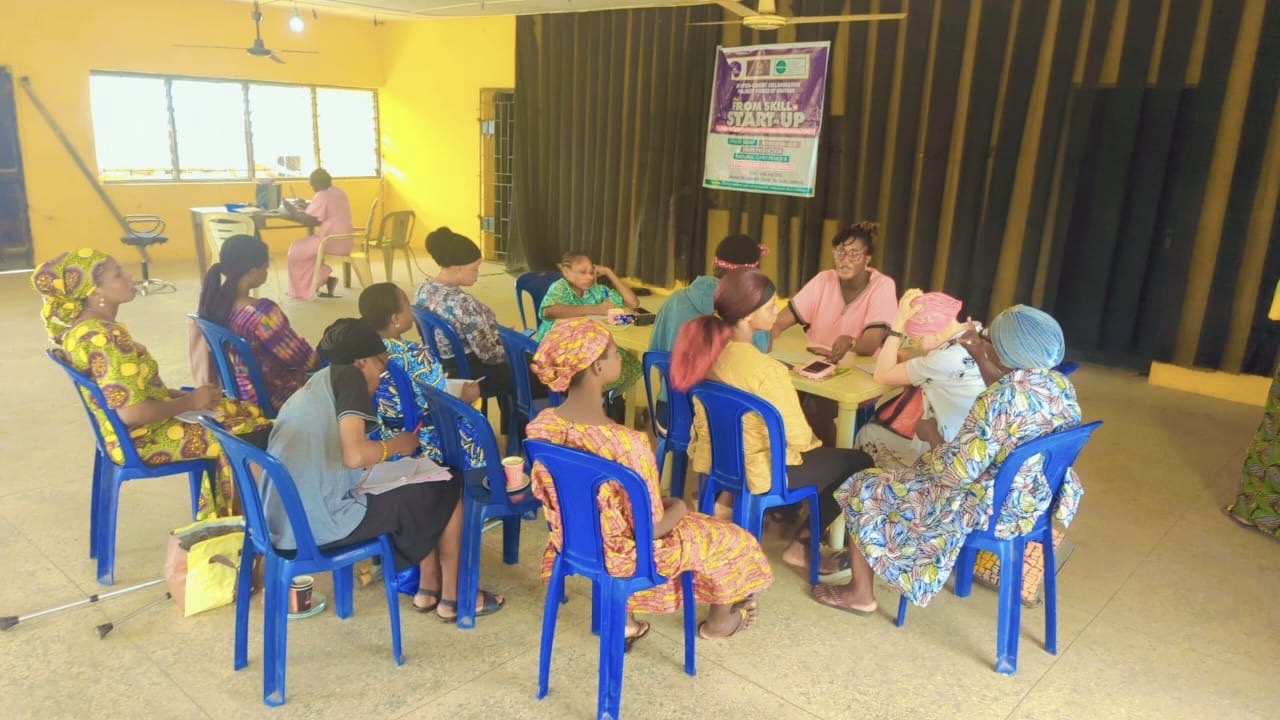
Instead of storing drinks bought from wholesalers, Abosede plans to fill it with bottles of fruit-infused zobo she now knows how to make herself. She was among ten women with different forms of disabilities selected for a three-day entrepreneurship programme in Abeokuta that taught participants to produce fruit-based zobo drinks, liquid soap, petroleum jelly enriched with Vitamin E and essential oils, and natural curry powder.
Unlike many empowerment programmes that end with speeches, cash gifts or food items, this one tested a narrower question; could practical skills, entrepreneurship training and modest startup support help women with disabilities build livelihoods that outlast the training itself?
By the end of the programme, all ten women had learnt at least how to produce one product independently and left with a startup kit to begin selling. For Abosede, that meant walking away with a plan already forming.
I already have a freezer,” she said. That will help me with the zobo business.
Locked Out of Opportunity
Abosede’s experience reflects a wider reality facing millions of Nigerians with disabilities. Across the country, persons with disabilities continue to face significant barriers to education, employment and financial independence. Disability advocates argue that inaccessible infrastructure, discrimination and limited economic opportunities remain greater obstacles to inclusion than physical impairments themselves.
The numbers support that claim. According to the 2024 National Bureau of Statistics’ Labour Force Survey, about 80 per cent of Nigerians without disabilities participate in the labour market, compared with just 36.7 per cent of persons with disabilities. For women, those barriers are often compounded by gender inequality, leaving many with fewer educational opportunities, lower employment rates and greater dependence on family or informal support systems.

The employment gap between Nigerians without disabilities and Nigerians with disabilities. Credit: Fawaz Adebisi
Ogun State illustrates the scale of the challenge. In 2025, the Joint National Association of Persons with Disabilities, JONAPWD, estimates that about 1,032,221 persons with disabilities live in the state, part of a broader national projection of roughly 34.9 million Nigerians with disabilities, a figure JONAPWD unveiled at a press conference in Abuja and derived by applying the World Health Organization’s benchmark that persons with disabilities account for around 15 per cent of every population to National Population Commission projections.

Top States with PWDs in Nigeria. Credit: Fawaz Adebisi
JONAPWD acknowledges the figures are projections rather than census data, and likely underestimate invisible disabilities and children with disabilities. Even so, they reveal a population whose economic needs receive limited policy attention.
Within Ogun, physical disabilities, hearing impairments and visual impairments account for the largest clusters, yet employment opportunities remain scarce.

Persons with disabilities in Ogun state by type. Credit: Fawaz Adebisi
For many women, unemployment creates a cycle of poverty that extends beyond income: some become financially dependent on relatives, while others withdraw from public life because workplaces, markets and transportation remain inaccessible.
It was this reality that prompted the Beyond Limit Initiative for Women and Girls with Disabilities, in partnership with Kora Heritage Foods Limited, to design a response centred not on relief but on enterprise.
Beyond Charity
Supported by the Mandela Washington Fellowship Alumni Association of Nigeria, the initiative, tagged “From Skill to Start-up: Economic Empowerment for Women with Disabilities”, selected ten unemployed women representing different disability clusters, including albinism, visual and hearing impairments, intellectual disabilities and physical disabilities.
Organisers deliberately prioritised women with no existing income and survivors of gender-based violence. Over three days, participants each produced liquid soap, petroleum jelly, natural curry powder and fruit-based zobo drinks themselves, working through measurements, hygiene, packaging and branding rather than simply watching demonstrations.
Every participant received a startup kit worth approximately ₦25,000, ingredients, measuring cups, mixing equipment and packaging materials sufficient to begin a first production run without further outlay.
We’re providing startup kits to ensure that they’re able to go home, not just sit down waiting for somebody to give them money before starting, said Adeyefa Oluwatomisin, Executive Director of Beyond Limit Initiative.

Adeyefa Tomisin, Executive Director of Beyond Limit Initiative
They practise and start doing something, no matter how little, for themselves to earn a living.
Alongside production, sessions covered pricing, branding and customer confidence, as well as self-esteem and the discrimination many participants had faced for years. Oluwatomisin said the goal was to get women who had long been told what they could not do to instead see themselves as capable entrepreneurs.
Testing a Different Response
For many participants, the training’s value lay less in the recipes than in the confirmation that starting a business was actually within reach.
Kofoworola Komolafe, one of the beneficiaries, arrived uncertain the programme would differ from previous training she had attended. She left having learned a fruit-and-clove method for zobo she believes will distinguish her product in the market, a deliberate emphasis by facilitators, who pushed participants to think about what would make customers choose them, not simply how to manufacture a generic item.

Kofoworola Komolafe receiving her Kit
The quality of what you produce determines your pricing, Oluwatomisin said. Customers should buy their products because of the value they offer, not because they pity you.
Komolafe now plans to build gradually, reinvesting early sales into more materials as she goes. Abosede, meanwhile, sees home-based production as suited to her circumstances precisely because it removes the need to move around, and hopes to reopen a shop within seven months.
Not every participant was equally optimistic about what lies ahead. Olukunle Adeyinka, who is visually impaired and currently unemployed, welcomed the training but was clear-eyed about the obstacles still ahead: finding customers who may already buy from established suppliers, and delivering products without reliable transport. Abosede separately flagged a regulatory hurdle, obtaining a NAFDAC registration number, which she believes will be necessary to win customer trust for a food or cosmetics product.

Olukunle Adeyinka.
Those concerns point to the programme’s central limitation. It equips women with skills, materials and a completed first batch, but it cannot by itself create markets, cover certification costs, or guarantee financing.
Oluwatomisin was candid about the constraints behind the kits themselves: funding covered training, meals and logistics for the three days, leaving less for materials than organisers had hoped to provide.
Development advocate, Gbenga Gbesan sees this as the natural next phase rather than a flaw. Skills training, he argued, should mark a beginning, not an endpoint; beneficiaries still need mentorship, bookkeeping and pricing knowledge, and connections to financial institutions before their ventures can be considered established businesses.
He is already in discussions with the organisers about bringing in business development experts for future cohorts.
Can the Model Last?
Disability organisations in Ogun State say they have learned this lesson before. Adeyinka Adekunle, Chairman of the New Era Initiative for Persons with Disabilities, has spent four years supplying members with sewing machines, deep freezers and startup capital, only to find that equipment handed over without follow-up sometimes gets resold rather than used.
New Era now runs a monitoring team that checks in on beneficiaries to catch struggling entrepreneurs early, a practice Gbesan argues should extend across the sector: proper business structures, he said, give banks and development partners more confidence to invest.
The Abeokuta organisers appear to share that view. Oluwatomisin said the current cohort was designed as the start of an annual programme rather than a one-off event, with future editions potentially expanding into digital skills.
But she was direct about the scale problem: ten women is a small number against Ogun’s estimated population of over a million persons with disabilities, and funding remains the binding constraint on how far the model can grow.
Government involvement, advocates say, is the missing piece. Adeyemi Olayinka, JONAPWD’s Women Leader, said unemployment is only one of several barriers confronting persons with disabilities in the state, alongside inaccessible public buildings, commercial drivers who charge higher fares or simply refuse to stop for passengers with disabilities, and families who still keep children with disabilities out of school.

Adeyemi Olayinka, JONAPWD’s Women Leader
Without early education and skills, she said, many grow into adulthood without a path to earning a living. She called for the government to partner more directly with organisations like Beyond Limit Initiative rather than leaving the work to civil society alone.
That call for institutional support was echoed by the beneficiaries themselves. Adeyinka, the visually impaired participant, said she holds a disability certificate and a school leaving certificate and wants the government to consider her for formal employment, a reminder that entrepreneurship is one route to economic inclusion, not a substitute for inclusive hiring policy.
The Abeokuta initiative does not claim to have solved economic exclusion. It reached ten women, produced ten completed startup kits and ten women capable of independent production, and set no illusions about the marketing, registration and financing hurdles still ahead.
What it demonstrated is narrower but real: that women written off as unemployable can, with modest and well-targeted support, complete a working production process and leave with the materials to sell something of their own making.
Lessons Beyond Abeokuta
Advocates believe the programme’s design carries lessons beyond its ten beneficiaries. Oluwatomisin pushed back on the idea that disability inclusion requires large budgets: the accommodations that mattered most, an accessible venue, a sign-language interpreter, added little to the cost and simply required planning for them in advance.
The other lesson is a shift in how success gets measured: not by food packs or cash gifts distributed, but by whether people go on to earn sustainable incomes. Achieving that, advocates agree, requires more than a single training, a continuum running from skills and startup capital through mentoring, market access and business development.
Months ago, the freezer in Abosede’s home stored drinks supplied by others. Soon, she hopes it will hold products carrying her own label.
Whether that ambition becomes a thriving business remains uncertain, it will depend on customers, mentorship and support that no single training can guarantee. But unlike before the programme, the freezer no longer represents a business she lost. It now represents one she is building.
